Digital tokens are called cryptocurrencies. These are a particular kind of virtual money that enables direct online payments between users. Cryptocurrencies are only worth what consumers are willing to pay for them on the open market; they have no set legal or intrinsic value. National currencies, on the other hand, derive some of their value from being recognized by law as legal tender. There are several cryptocurrencies; Bitcoin and Ether are the two most well-known.
The marketplaces for cryptocurrencies are much busier now. The allure of these currencies seems to have stemmed more from speculative activity (purchasing cryptocurrencies to profit) than from their potential application as an innovative and novel payment method.
In line with this, the values of numerous cryptocurrencies have experienced extreme volatility. For instance, the price of Bitcoin rose from roughly US$30,000 in the middle of 2021 to nearly US$70,000 at the end of the year, and then it dropped to approximately US$35,000 at the beginning of 2022.
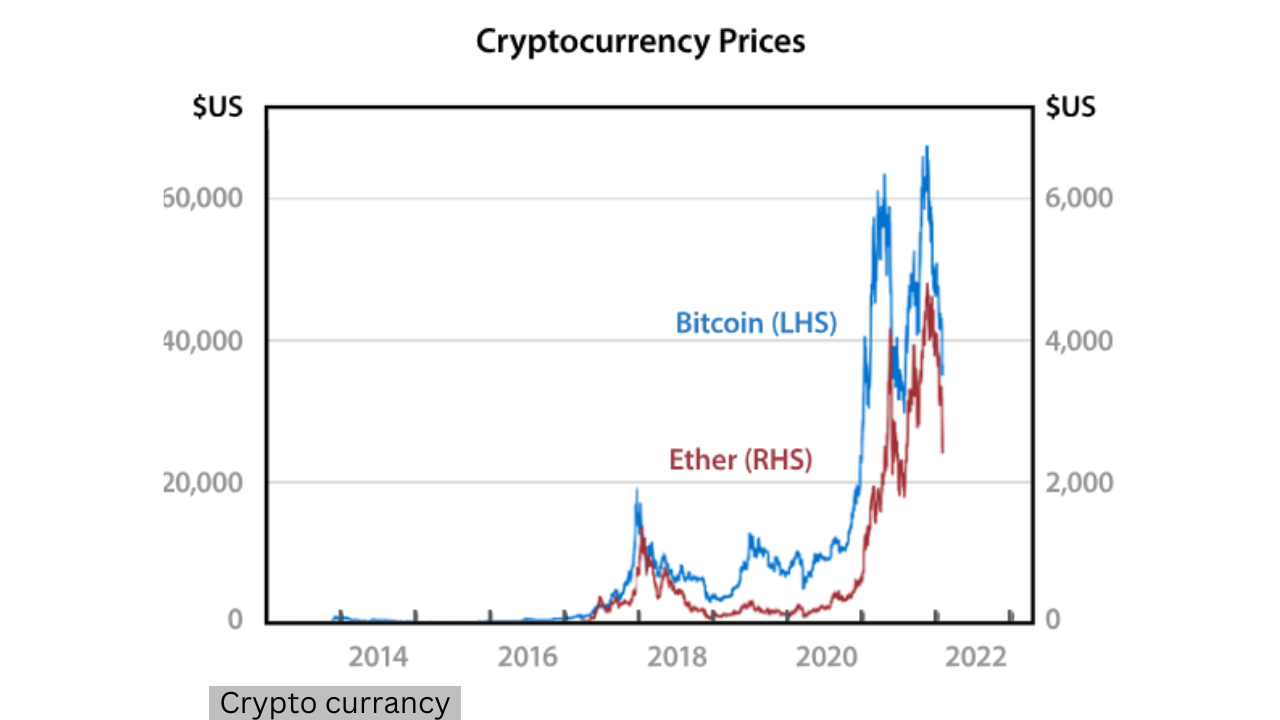
Ether and other rival cryptocurrencies have seen comparable volatility. Due to the high demand for cryptocurrencies, more processing power is being utilized to decipher the intricate encryption that many of these systems employ to prevent them from being.
What Is the Process of a Cryptocurrency Transaction?
Electronic communications containing transaction instructions are delivered to the entire network during cryptocurrency transactions. The instructions contain details like the parties' electronic addresses, money to exchange, and a time stamp. Let's say Alice wishes to give Bob one Bitcoin unit. Alice initiates the transaction by transmitting an electronic message to the network, visible to all users, including her instructions. Several transactions have been sent recently, including Alice's transaction. The transaction waits to be combined into a block, which is just a collection of the most recent transactions, along with several other recent transactions because the system is not instantaneous. To add a new block of transactions to the blockchain, miners compete to decipher a crypto.
After a miner solves the code successfully, other network users validate the solution and decide it is correct. Alice's transaction is validated, and the new block of transactions is appended to the end of the blockchain. (This is not an instant confirmation; users must wait for six blocks of transactions to be completed before they can be sure their transaction was successful.)
Cryptocurrency: Is It Money?
The question of whether cryptocurrencies can be classified as "money" is commonly posed. In a nutshell, cryptocurrency isn't a type of money. We can inquire as to whether the features of cryptocurrencies correspond with the essential elements of money to comprehend why.
Can cryptocurrencies be used as a widely recognized form of payment to buy and sell goods? Money is commonly accepted as a form of payment and typically takes the shape of a country's currency. Although cryptocurrencies can be used for both buying and selling, only a small percentage of cryptocurrency holders routinely use them for payments, according to studies, and they are not often accepted as a form of payment.
Store of value: Can cryptocurrencies' buying power their capacity to pay for a comparable assortment of products and services—be sustained over time? Many cryptocurrencies have significant price swings, which makes it harder for them to retain their purchasing power over time and less useful as a store of value.
Unit of account: Do people often use cryptocurrencies to calculate the worth of products and services? Australian dollars are used to measure prices for goods and services in Australia. Although bitcoins might be accepted as payment by certain establishments, price comparison and measurement using them is uncommon.
Therefore, even if cryptocurrencies can be used to make payments, their application as a payment method is still restricted, and they lack the essential features of money.
Digital currency issued by central banks is one kind of digital currency that might be regarded as money, nonetheless.
Central Bank Digital Currency: What Is It?
The easiest way to conceptualize a Central Bank Digital Currency (CBDC) is as a digital version of cash. It can be used to settle transactions between businesses and households, be issued by the central bank, and be made available to the general public. The national currency would serve as the unit of account and could be exchanged for other currencies at parity, or one-for-one, with other financial institutions that are subject to regulation or with actual currency or electronic deposits.
What key distinctions exist between CBDCs and cryptocurrencies? That is, what generates revenue for a CBDC? A central bank can guarantee that the digital currency it produces demonstrates the three primary characteristics of money, meaning a CBDC can serve as a commonly recognized form of payment, a store of value, and an accounting unit.
A CBDC would have legal tender status due to its issuance by a central bank, making it a commonly used form of payment. Since a CBDC could be exchanged for a similar amount of cash or electronic deposits, it would also be a store of value comparable to other currencies. Ultimately, the Reserve Bank's CBDC unit of account would.
Which Public Policy Implications Are There?
There are several technological aspects of cryptocurrencies that public authorities should take into account. Given the global reach and anonymity offered by cryptocurrency systems, there are concerns about how to restrict the use of digital currencies for illicit purposes. Concerns regarding consumer protection have also been highlighted by the current infatuation with cryptocurrencies, which may have contributed to the speculative nature of these marketplaces. The wider adoption of cryptocurrencies may pose certain challenges to the banking industry's position and give rise to further worries regarding financial stability during a crisis. In addition, the enormous amounts of electricity required for cryptocurrency mining pose questions about resource allocation and the environmental effects.
On the other hand, a CBDC might be able to help achieve several goals related to public policy, such as preserving the public's faith in money and encouraging the payment system to be more resilient, efficient, and innovative. The Reserve Bank is collaborating with other central banks on this matter and is still attentively examining the case for a CBDC. The Reserve Bank is thinking through the wider policy implications in addition to the pertinent technical difficulties.
graphics code that is created using the information from the block.
After a miner solves the code successfully, other network users validate the solution and decide it is correct. Alice's transaction is validated, and the new block of transactions is appended to the end of the blockchain. (This is not an instant confirmation; users must wait for six blocks of transactions to be completed before they can be sure their transaction was successful.).
'Crypto News' 카테고리의 다른 글
| Which crypto will boom in 2024? (0) | 2024.02.15 |
|---|---|
| Is Genesis crypto safe? (0) | 2024.02.14 |
| How much crypto do you have to report on taxes 2024? (0) | 2024.01.19 |
| What is the best thing to buy in crypto? (0) | 2024.01.19 |
| How do I get news about crypto? (0) | 2024.01.16 |


